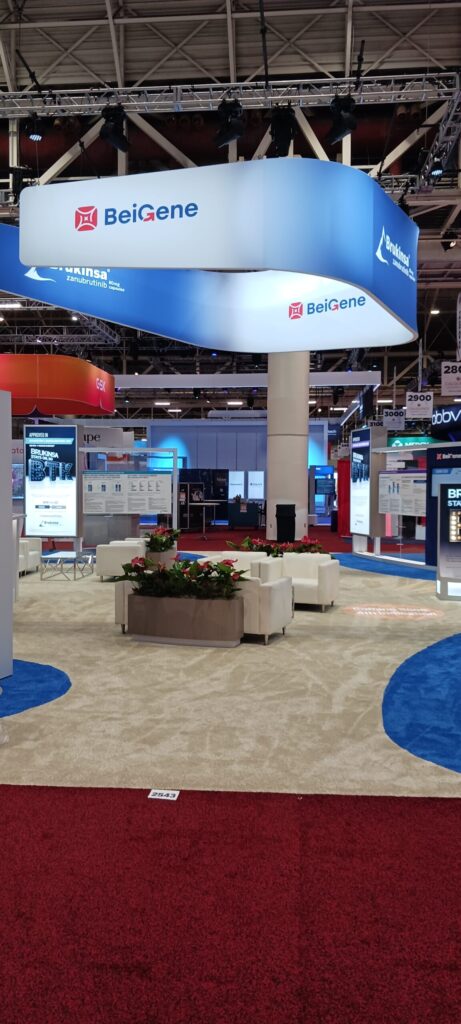
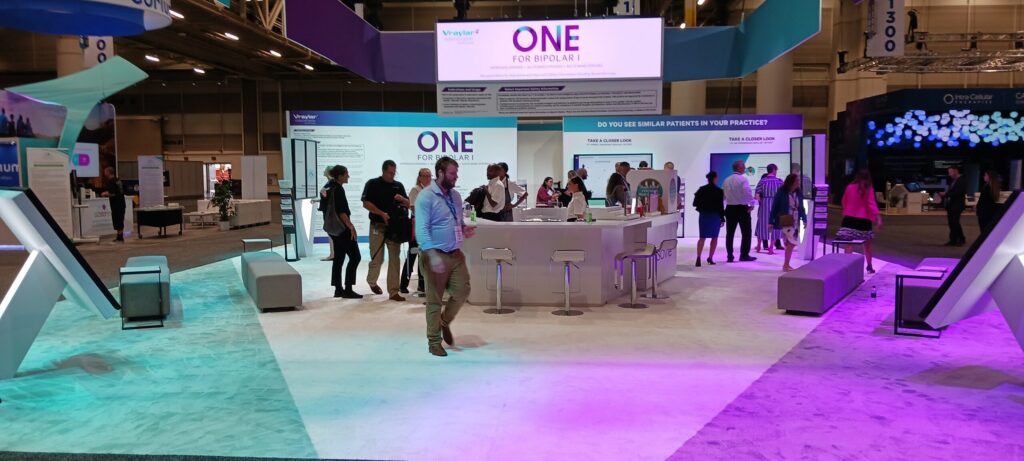
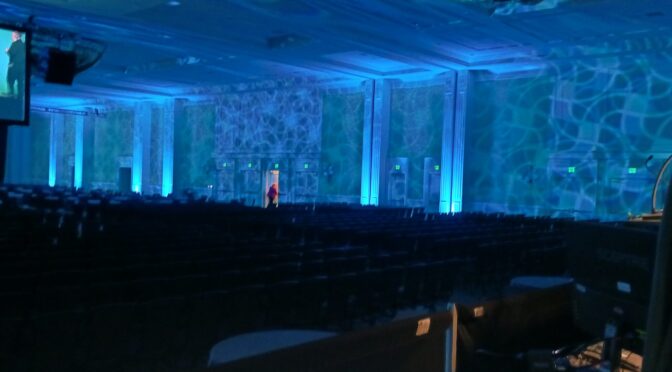
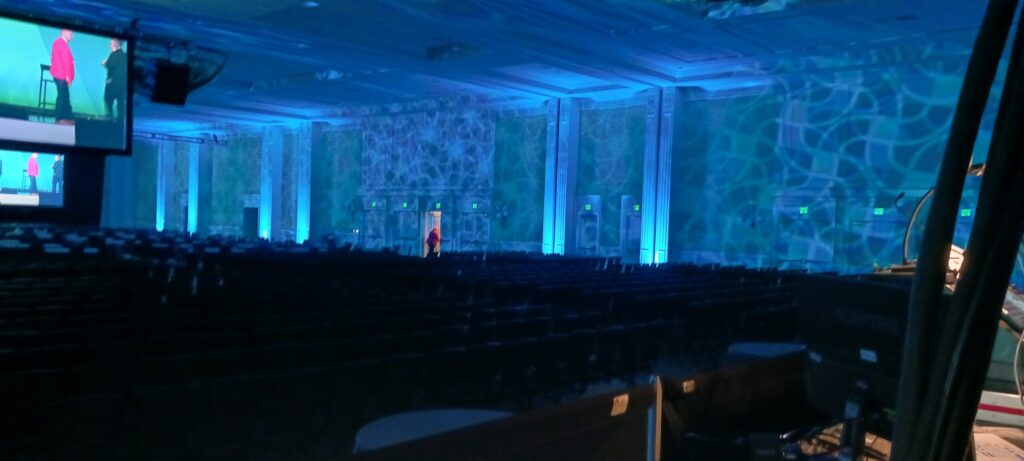
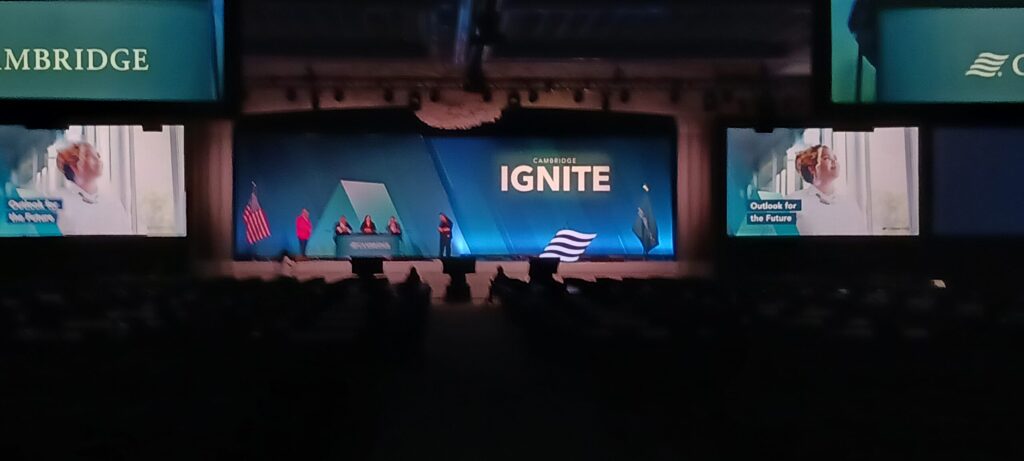
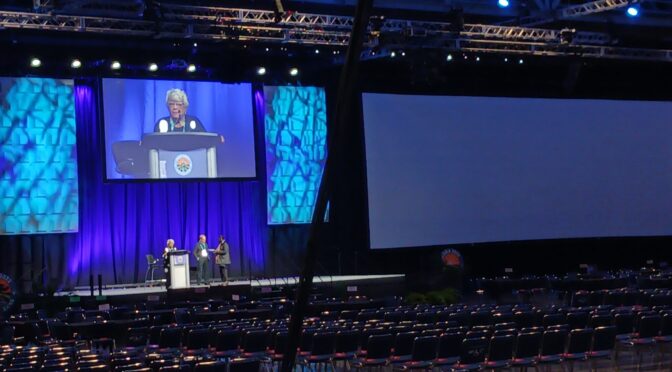
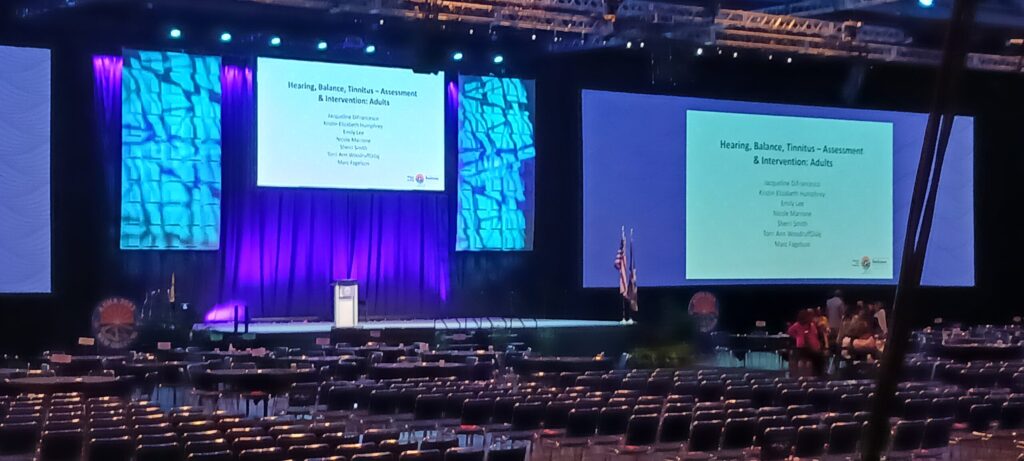
Last month, with a little hole in my schedule, an old work contact brought me in to oversee the set up and running of a small series of technical symposium breakout rooms for a scientific conference in New Orleans.
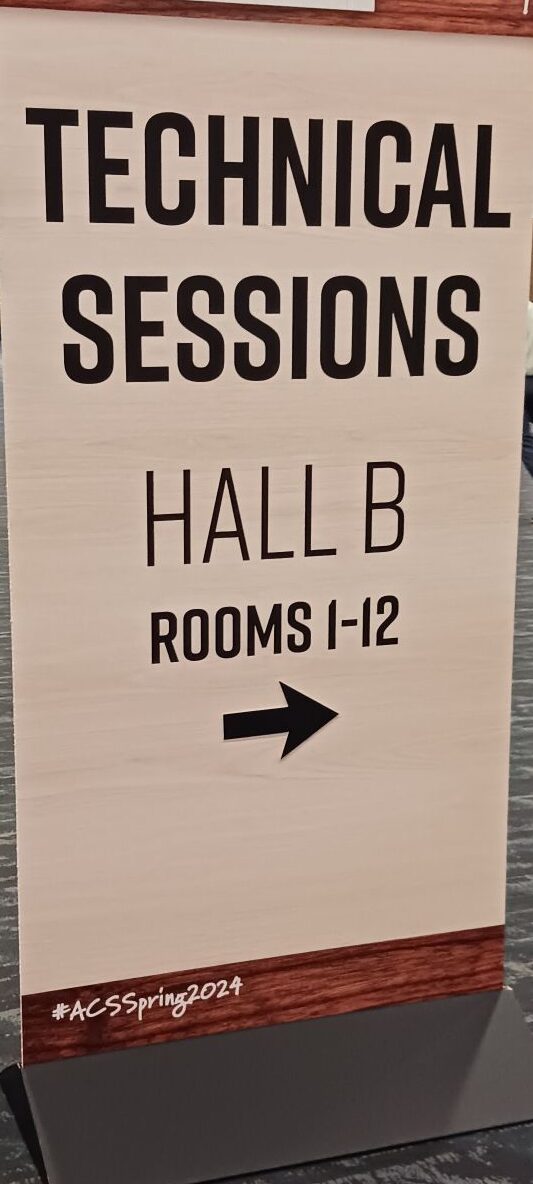
This Sign points the way to Hall B and 12 constructed rooms for specific topics in science.
Fortunately the scenic company completed the rooms earlier than scheduled so I set to work setting them up. And rather than having to do it in one day we had 2 full days to work on it.
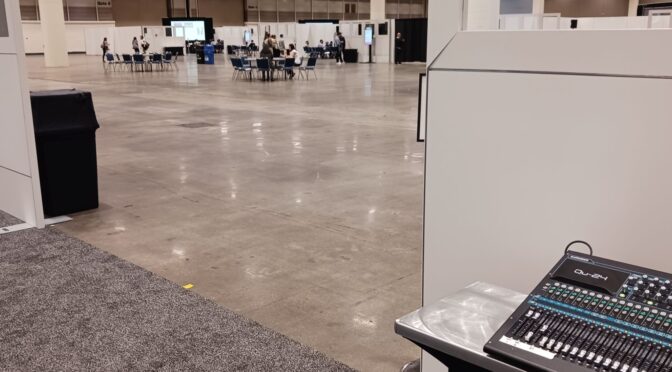
The rooms were all the same. 2 wireless mics, a Allen & Heath digital audio console with a digital stagebox, 4 powered speakers, 16 x 9 Fastfold Screen and Panasonic projector with a very short throw lens.
I split the teams up based on their strengths and we tackled the rooms systematically. 2 people on speaker set up and taping, 2 audio techs working on the wireless and console at the tech table.. 2 video techs working on laptops and projection.
These 12 rooms were handled by a crew of 5, 4 other techs and me. It was fairly simple to keep the presenters happy.
There were a couple challenges as presenters wanted to present from their own laptops for various reasons (mostly having to do with the IT security of their devices) and we faced resolution mismatches on the projectors but once we identified this it was easy enough to correct.
At the end of the event we started to strike the systems as the rooms finished up and by the end we completed the strike 4 hours early freeing up my strike crew for other duties with the larger conference crew.
I don’t usually handle breakout room crews but this gig was a good reminder I could still do it.
Every once in a while I get a call to sub into a load in or a show. Often it’s for a fellow LD that I know well. Sometimes it’s just a random meeting in a convention hall or ballroom.
Early in March I was called into that situation. The LD who was going to run the show couldn’t make the load in because the client moved the date up and he was on another show. No Problem.
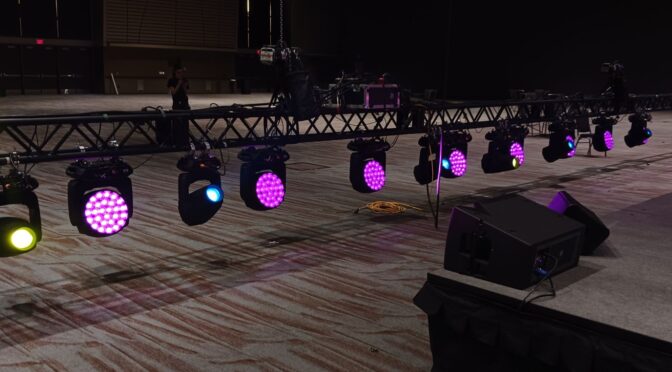
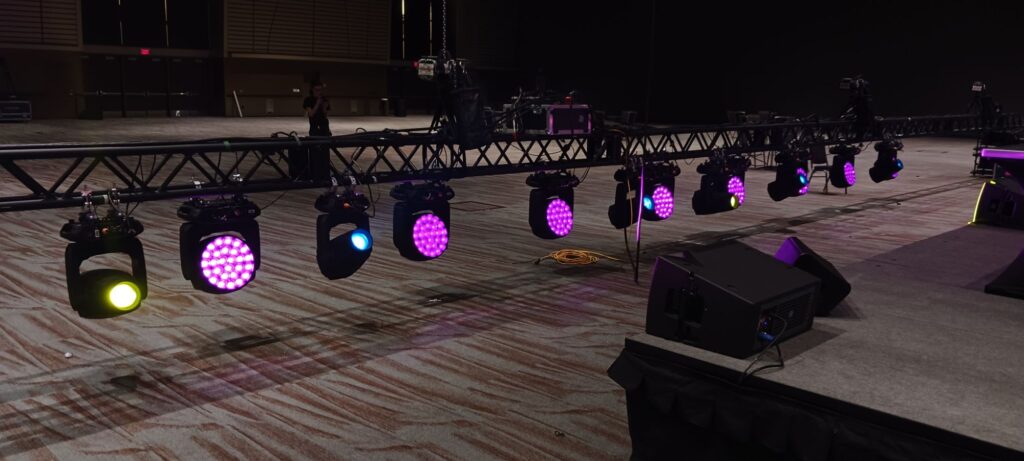
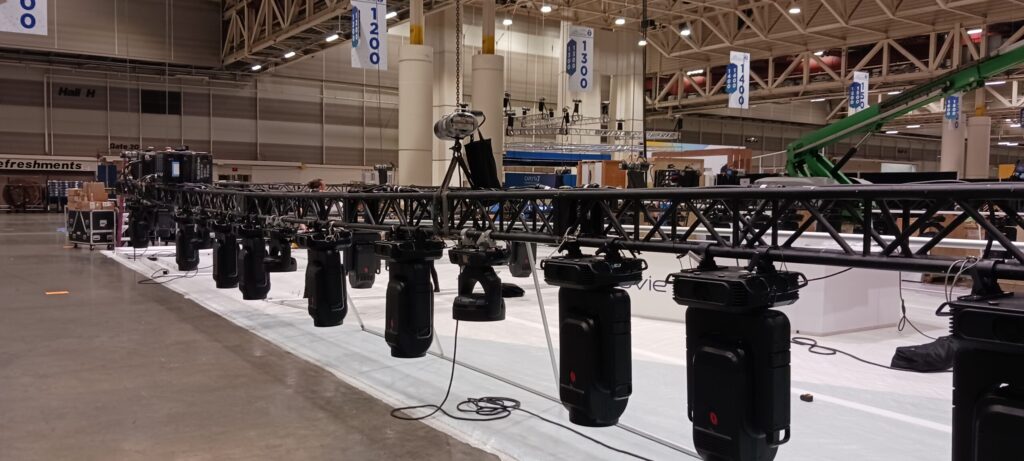
The kind folks who booked me for the show sent me a gear list from the production company. The console was a HOG4 so it was easy to get a patch up. The gear was a mix of moving Wash and Spot fixtures. I asked a few questions of the Production Manager and was off to the races.
We quickly laid out the truss and got it hung and floated.
Laid out the couple dozen strip lights for the drape.
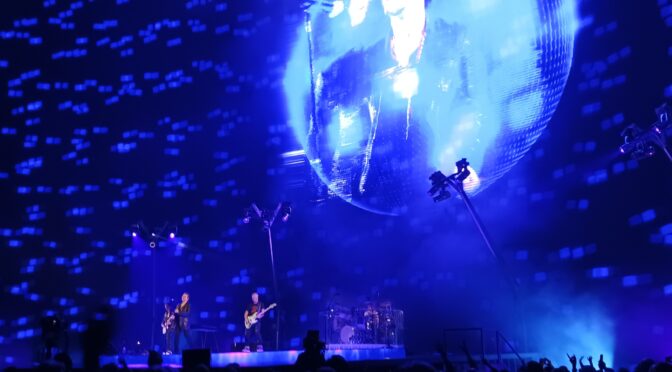
While I was in Las Vegas I had the opportunity to check out the U2 show at the Sphere. Now I think everyone who works in Event Production and Entertainment should probably check out that venue at some point. Particularly if you work in Lighting, Video Content and Audio.
The Performances
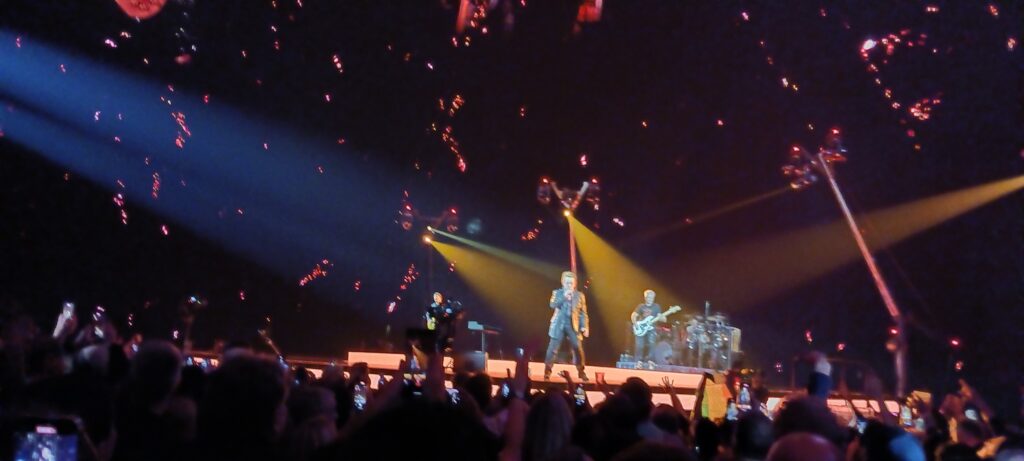
Granted it was the middle of the run and U2 was clicking on all cylinders with their performances. My ticket was on the floor and so I had a fairly up view of the band.
The set list leaned heavily on the Achtung Baby album which was just fine with me. But this isn’t really about the set list. It’s more about the production.
Bono was mostly able to hit most of the notes and was an affable host to the evening. I had never realized the degree to which The Edge added to the background vocals but being able to see the performances helps me appreciate his contribution to the vocals more.
The Audio
I’m going to get the audio out of the way first. I had seen the movie at the Sphere, Postcards from Earth, when I went to Las Vegas for LDI back in December, so I knew that the audio rig had the ability to do some wondrous things with placing sounds spatially around the dome.
The audio for U2 seemed to almost always be coming directly from the band. At points the audio seemed almost mono and flat it was so directional. Clearly there were moments when the sound was enhanced by tracks that would have been a great opportunity to bring some sounds from other positions in the system.
The Video
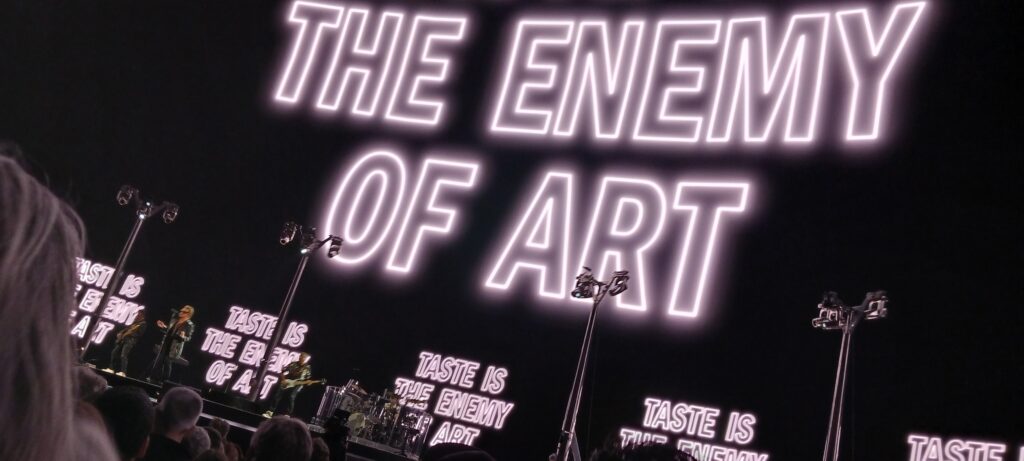
When the video was working and it looked like they had put some thought and time into it the video wall that is the Sphere was spectacular. The designers did an excellent job of making the room feel taller than it was…. and then designing spectacles that made it feel like it was closing in on you. Almost all the video design made it appear like the inside of the dome was the same height as the outside of the dome, adding what I’m estimating to be about 60 – 80 feet of visual height to a dome that is closer than you think.
And where they tried it was pretty spectacular.
They had a sequence where they projected an image of the Las Vegas Strip on the dome as if you were looking out on it from your vantage point. And then proceeded to deconstruct all of Las Vegas until it was nothing but the scrub desert the valley had been before all the construction. Visually stunning.
In another segment they took iconic images of Las Vegas, including Elvis and many of the older Neon signs from long gone casinos and packaged them as if they were from a Bollywood poster. These images floated down from the ceiling and when they came to the level of the stage it initiated a perceived motion that the stage was rising continuously.
There were other “perceived motion” moments in the show. A sequence where a sphere floated towards the audience and then turned to take them inside. Moments when they covered the entire virtual ‘dome’ in insects until they blotted out the blue background. When it was working it was really working.
For about 2/3rds of the show they used the visuals for all they were worth. But there was another 1/3 of the show where I felt like they primarily used the screen to show the band making them the worlds largest Imag rig. It seemed a waste of the technology and a missed opportunity. The way I put it to friends at the time “They’re pulling in probably 10 million a night, they can afford to hire a designer for these segments”.
The Lighting
It’s really hard to talk about the lighting because for the most part there really isn’t any. Most concerts, you walk in and are immediately confronted with a lighting rig that has probably 50 – 100 or more lighting fixtures visible and expected to play a big role in providing visual interest. The U2 lighting rig had 14 visible fixtures behind the band primarily providing backlight for the performances. There were a couple sets of floor fixtures that they used at one point to project shadows and maybe 20-30 strobe fixtures that they used for a couple segments hidden behind the LED panels behind the band.
If the Sphere is the future of live entertainment the Lighting Designer is going to have a significantly reduced role. in the future.
A sidebar.
The lack of lighting in this show and what it might portend for concerts and entertainment going forward is something that concerns me. LED screens are getting better, cheaper and easier to deploy. But in a lot of cases the content hasn’t caught up.
This reminds me of a time, back in the mid 90s when I was primarily working in theatre but was also doing some work as a set designer for an educational film company. The Silicon Graphics convention came to town and I was working it. On the exhibit floor among all the other computer generated content was a display of a virtual set. A greenscreen room in which, on the camera was turned into a standard issue living room. And a display of a virtual news studio. I pretty much knew then that a lot of the educational design and construction work was gonna be handled by computer programmers and designers. And we are starting to see that in the lighting is going to be impacted by this, from the minimal lighting at the Sphere to use of the Unreal engine and some designers using an integration to design and operate virtual light rigs for virtual sets.
It’s gonna be a wild time for lighting going forward. The good news is they still need us to light the people for the cameras.
The Venue
The Sphere as a venue is a pretty cool place to see a show, particularly if the video designers are working at a high level.
The couple of knocks on it are:
1- The Food and Beverage are at the high end of the Las Vegas resort prices. It’s to be expected but it is still annoying.
2- They need better plans/routes for getting people in and out of the place. Most of the people enter from a bridge connected to the Venetian. They need to extend this bridge to the other side of the venue so that people more ways in and out of the venue. There are, as far as I can tell 2 ways in at ground level for the folks with General Admission floor tickets and even those are kind of tight.
Once in there are a limited number, maybe 2, escalators to get to upper levels and the staff is very concerned with overloading them. This isn’t just a convenience concern as it could make it very difficult to evacuate the Sphere if there is an emergency. If there were other ways to upper levels than the 2 escalators and 2 elevators I found they weren’t really sharing that.
Wrap up.
Well, that’s about all I have. I would catch this show again if I had a U2 fan who was desperate to go. And I’d catch other shows at the Sphere if it was a musical act I was interested in. It’s going to be interesting to watch over the next couple years to see what acts get booked in there and who does the most interesting things with the venue.
Since 2002 I’ve been working with the audio team, most years, at the Superbowl Experience. I started out balancing sound over a decentralized house PA system over the entire event, which in 2002 meant keeping the appropriate levels for 2 or 3 Halls of the New Orleans Convention Center and a village of Tents and structures outside on a grassy field across the street. At the time that meant walking from location to location and adjusting the volume on 4 channel mic mixers as the crowds grew and ebbed at the end of the day.
Now, fast forward a couple of decades and I’m now running the PA system from a centralized location that allows me to have control over all the zones at the event from one audio console but I’m also making the announcements.
This started casually in the Miami Superbowl of 2007 when the intern who was supposed to make the announcements was continually missing in action and management was desperate to get people to leave at the end of the night. I solidified the PA Announcer/Operator role in at the Tampa Superbowl in 2009.
Over the years in this position I’ve developed a script and am often called on to choose the background music. My joke about the position is “I get locked in a room with a sound board, a microphone, a script I’ve developed over years, 6 ways to get at me (in case of emergency or a marketing ad I have to read), and all the Top 40 I can tolerate, and while I can’t play anything I want I can spike anything I hate and that’s enough control to keep it from being too painful.”
Being responsible for possible emergency announcements means that I can’t stray too far from my console.
I’ve been in the deepest recesses of Convention Center amp and patch rooms where none of the crew could find me, awaiting the next call or for the time to reach 9:30 pm to get there so I can tell people that we are closing in 30 minutes. Most of the staff doesn’t know what I look like but if I say “Your attention please, the Superbowl Experience will be closing in 30 minutes” I will usually get “Oh, that’s YOU!!” People like it when you play the hits, particularly when it means they get to go home soon.
Its not like I’m unfamiliar with how most audio works. I’ve run audio for hundreds of smaller meetings in hotel ballrooms. I’m comfortable with smaller stick PA systems and the usual compliment of Podium mic, wireless lavs and handhelds and the computer sound interfaces. But in the past couple years I’ve concentrated more on my lighting skills.
Still, it’s fun, at least a couple weeks a year to play on Team Audio.
What started as a phone call about renting a USB to DMX interface ended up being a years worth of livestream shows in a Mardi Gras float den and a little grocery money.
Spent one night a week making the lights flash and wiggle and began to learn you can do a lot with some pretty cheap lighting fixtures if you pay attention.
It was like concert plus video lighting and I took over from some very capable LDs who initiated this project.
Still it was a good way to get myself out of the house and keep the skills sharp (or at least not deteriorating)
We started on Hog for PC and finished the run on Chamsys which I eventually ended up teaching to the intern when shows returned in 2021
Catch some great performance by New Orleans musicians and see what happens with a handful of $100 movers.
One type of job I’m just getting into is building and focusing booth lighting rigs. It’s a different world when the plot comes from a room somewhere and is clearly the product of hours of phone calls between the booth client, the scenic company building the booth and the in-house lighting design team of a big lighting company. It’s a different way of working that requires you work thoughtfully, collaborate with the scenic team and exercise patience as the elements of the build spring up over the hours it takes to implement a design.
Then it’s time to focus and make the lights work as the designer intended and make the appropriate and necessary changes on the ground.
And then the people come and you do the day to day maintenance of the rig.
I didn’t think I would like doing booths. But they have become a good distraction from the usual General Session days.
Every once in a while I have a client who LOVES to have floor to ceiling, wall-to-wall patterns for their shows. I really love the look here. And what you don’t see is the subtle movement that I did as the audience arrived. Of course I stopped it once the show started so it wouldn’t draw too much focus.
Like a lot of New Orleanians, 2005 with Katrina, the flood and the subsequent years of rebuilding changed my perspective on the city of New Orleans. Primarily it lead me to change my focus from activities like writing plays and screenplays to thinking about the municipal policies to keep New Orleans surviving and thriving for the next 300 years.
The short answer take away: New Orleans needs more population with good jobs through economic development, and much of the policy at City Hall needs to be focused on that. We need policies that encourage business development and in-migration and housing policy that spurs on more investment and building of a modern housing stock.
I lay out many of these ideas in 3 websites. Some of them need updating. I’ve moved on from some of these positions but I think that keeping them up with the dates are important as a way to show the ways in which my thinking has changed on them.
Alive New Orleans lays out the overarching theme of population through good jobs and economic development by having a more permissive zoning code but, right now, as I write this the themes aren’t fully fleshed out. But this will probably help me work more on this site.
This was a project I worked on in the first 5 years after the storm. It was largely a disaster recovery project that tried to address policy failures I saw in the post-disaster planning era. It has some civic media designs that I considered akin to something like 30 s and 40s era posters encouraging citizens to do their part for the effort. It also lays out my opposition to the city’s “Master Plan” which I considered, and still consider a mistake that unhelpfully empowered those opposed to economic development
The Corner Store Initiative was designed to highlight the ways in which the current zoning code led to blighted buildings and reduced economic opportunities for neighborhoods by making it difficult or impossible for businesses to occupy former corner store sites that dot our neighborhoods.
These are just a sample of some of the thinking I’ve done about municipal policy in New Orleans. There are also PowerPoint decks and an unfinished album which I describe as “making the zoning code danceable”. Because I love my city and want to see it and its people survive and thrive.
Like a lot of my websites it has suffered from lack of updates lately but working on this website has encouraged me to start looking at other websites I have with an eye towards updating them.
Once in a while I get to do a show in the New Orleans Convention Center Halls. I forget the association but it was a good show with a good crew. I ran it on a Chamsys MQ70 and we had 4 universes of lighting fun.